The Whalers and the Wire
1. The Wrong Door
A man with a rectourethral fistula spent months trying to reach me. After treatment for prostate cancer, a hole had opened between his rectum and his urethra, and he was passing stool in his urine. He knew my name. He called the number on the website and asked for me. The call center could not tell whether a hole between the rectum and the urethra was a colorectal problem or a urologic one, and when he asked for me by name he was booked with colleagues whose names resemble mine and whose practices are in other diseases. He saw two of them. Each tried to send him to me, and each time the call center sent him somewhere else, until one called me personally after work. Eight months passed with urine coming out of the anus before I was able to offer treatment.
Nothing about his case was hard to diagnose. The hard part was the door. Everything needed to route him existed on the day of his first call: the words he used, the surgeons who treat that problem, their schedules. There was even a directory rule for routing him. The call center did not follow it, and nobody checked that it was being followed. That includes me. The building is mine to inspect, and I had not. He paid for it in months. He is not unusual. My name is common, and colleagues with names like mine have the same problem. In the last year, dozens of patients who asked for me by name were sent to someone else first.
The same gap has now been measured.
In a trial published this year, 1,298 people in the UK worked through written medical scenarios, each with a hidden diagnosis and a right answer for how urgently to seek care. Most could consult an AI model (GPT-4o, Llama 3 or Command R+). A control group used whatever they normally would. Given the full scenario directly, the models named the right condition 94.9 percent of the time. With a member of the public in between, typing the case in and reading the answer out, that fell to under 35 percent, worse than the control group. [1]
The intelligence is in the box, but a layperson in the loop made it worse.
My colleagues read a result like that and hear two different things. Some hear that the machine is already better than the patient and will soon be better than us. Others hear that the machine should be kept away from patients altogether.
2. What I Produce
Every week I explain to a man who had radiation for prostate cancer why his urethra has scarred, why stretching the scar rarely holds for long, and why the repair is planned around the damaged tissue rather than the narrow spot. The anatomy is the same every time. The decision is not: his continence, what has already been tried, and what he will accept. I had given the talk often enough that I recorded it (How radiation changes the water pipe), so the part that does not change happens before the visit and the visit can start at the decision.
That talk is a product. A great deal of medical work is the same product: intelligence made by hand for one person at a time. Explaining the anatomy, answering the portal message, working out which clinic the patient belongs in, finding an open appointment, translating a guideline into a plan. Coordinators, nurses and clinicians make it, and the system pays for it in a person's time. A chatbot makes a cheaper version of that product, and the people who make it by hand know it. That is the fear, and it has a history.
3. The Hunt for Light
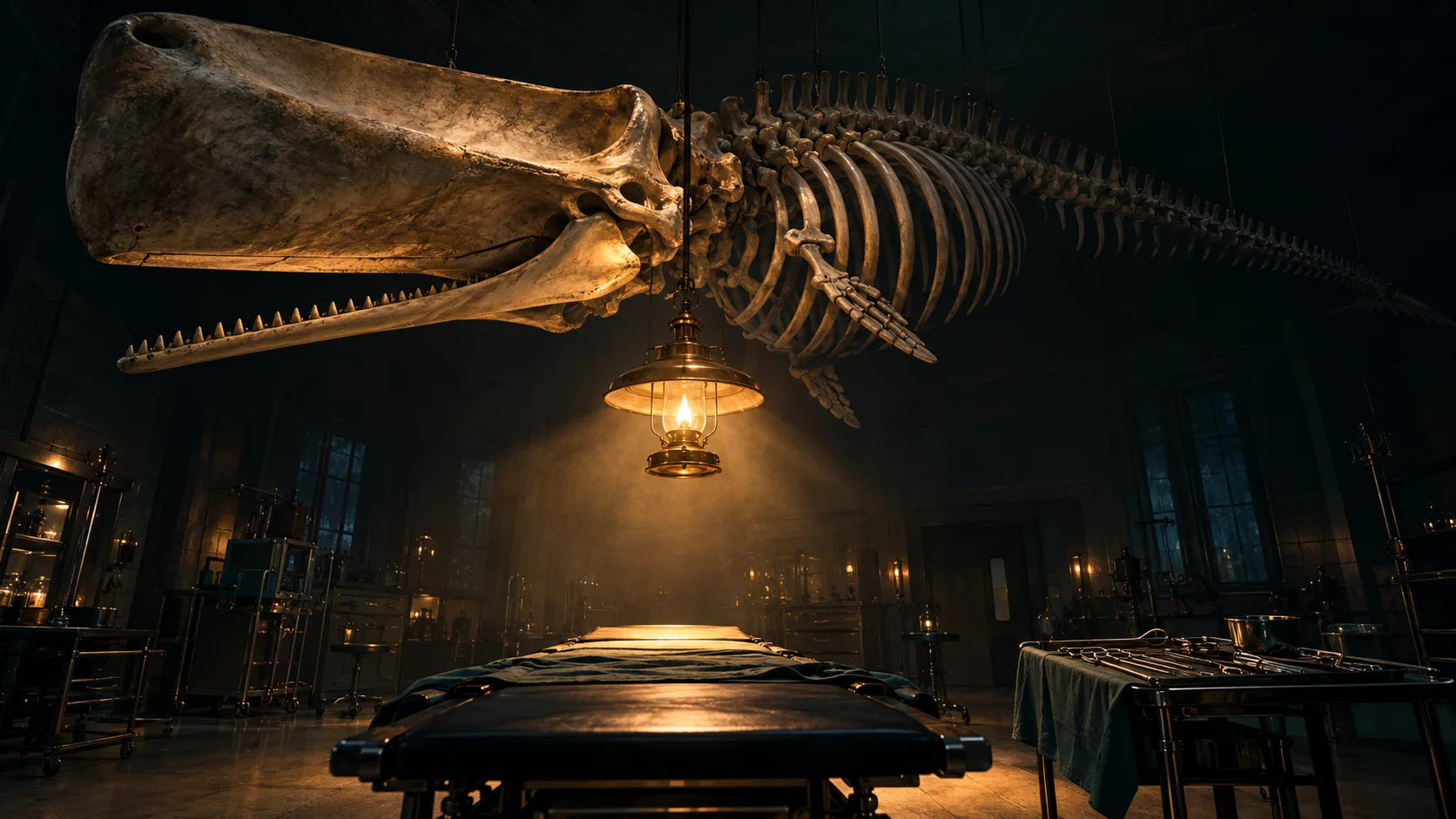
"Call me Ishmael." Moby-Dick opens in 1851 with a man who goes to Nantucket to ship on a whaler, and the book is about men who hunt light: the whaleman, Melville writes, "as he seeks the food of light, so he lives in light." [2] By the time the book was in print Nantucket's trade was already failing, and what finished American whale oil a decade later was kerosene, refined from the Pennsylvania oil struck in 1859: a cheaper way to make the main thing the whalers sold. [3]
Electricity came a generation later, in 1882, from Edison's station on Pearl Street. [4] In time it replaced the kerosene lamp too. But it also did something kerosene never did. For decades factories bolted an electric motor onto the old steam layout and gained little; the gains came when the floor was rebuilt around the new power, and every job on it changed. [5]
So a new source of power can do two things to your work. It can make a cheaper version of the thing you sell, which is what kerosene did to the whalers. Or it can change what every job in the building looks like, which is what electricity did to everyone else. A chatbot that only replaces the talk is kerosene. So is my video. The question for medicine is whether the second thing is coming, and what it would look like.
4. The Wire
Ask my patients what was hard and few of them say the operation. They say they did not know what to do: which doctor to call, how to get an appointment, why the referral took months, why they arrived without the imaging that would have made the visit useful.
That friction is where cheap intelligence could do the most good, and there is one trial about it. At a hospital in China, 2,164 outpatients were randomized to reception nurses alone or to nurses working with a chatbot built for that site. With the chatbot, patients reported higher satisfaction and asked fewer repeated questions, 3.2 percent against 14.4 percent. [6] A reception desk, one hospital, satisfaction as the endpoint. It does not show that patients reached the right clinic faster. It shows that a model placed inside a path the hospital designed, with nurses beside it, did its job.
Set that beside the UK study, where the public was handed the model with no path at all and did worse than without it. [1] My bet is that the gain is not in the model. It is in the path built around it, with a clinician at the points where judgment is needed. Electricity did not light a house until someone wired it.
Here is the wire I want built: the patient's question reaches the right clinic, with the right imaging and history, before the first visit, and the first visit starts at the decision. Pieces of that exist in every health system. Nobody I know of has built it as one path with a clinician at the junctions. If someone does and the patient still arrives at the wrong door without imaging, the wire did not help and I was wrong.
5. The Case Against
The first objection is that this is an easy optimism for a surgeon to hold. My work is with my hands, and the robot still needs me at the console. The people whose work most resembles making the old product by hand carry more of the risk: in my own practice, the coordinator answering the portal messages, the scheduler finding the OR slot, the nurse giving the same preparation instructions for the tenth time that day. If the explaining moves to a video, those hours have to go to the patient who did not understand it, the unusual case, and the person who needs to hear it from a person.
The second is that the history is not as kind as the analogy. Nantucket did not adapt. The island emptied, and the people who had made whale oil did not become electricians. A transition that is good on average can still be bad for a particular place and a particular trade.
The third is safety. A chatbot that answers "which clinic do I go to" is not the same as one that tells someone to stay home with chest pain. The UK study is the warning: benchmark scores do not predict real use, and its authors call for testing with human users before public deployment. [1] Making care easier to reach does not make it safer.
I accept these objections, but none of them is a reason to wait to build and test. The patient at the wrong clinic with urine leaking out of his anus is paying for the old way now.
6. What to Do
For trainees first, because you ask the question I hear most: will there still be a job, and what should I learn now?
Learn what electricity cannot do yet. I have written that the career never stabilizes, because each new platform resets a senior surgeon to a beginner. [7] AI is another such platform, and for now what it resets is the explanation, not the operation. I would not bet that the operation stays safe for your whole career. What I can say is where the learning is densest: the redo, the complication, the pelvis that has been radiated and operated on twice. Those are the cases where no model yet knows which detail will undo the plan, and where you learn to.
Use the model to drill judgment, not to skip it. If it writes your note, you have saved some minutes. If you write the plan first and then ask it what you missed, you have had a rep. Mastery is knowing which details matter. [8] A model can explain every detail of an operation without knowing the most important one. That is still your job, and when the model is wrong, the responsibility is still yours.
The explanation work will change. Discharge counseling, the pre-op phone call and the portal reply are where you learn what a complication looks like from the patient's side. Expect to stop writing them from scratch and to start auditing what the model wrote. The exceptions it gets wrong are where the learning now is.
For attendings. Sort your work into three columns: explain, navigate, decide. The first two are where a path can be built. Decisions hide in all three, since which clinic to route to is a decision and which risk to mention is a decision.
Keep a clinician in the loop. Neither trial proves that supervision is what made the difference, but a clinician in the loop matters because someone has to notice the error and own it, and a model cannot. The clinicians in my patient's story were in the loop and tried to route him; the call center turned him back twice. A clinician in the loop is only as good as the channel that carries the decision. Wherever a model touches a patient, decide before it is switched on where a clinician reviews, who owns the error, and whether the route they choose will hold. In my practice the owner is me.
Then the Hippocratic question. Surgeons, like whalers, believe in hard work and the skill it takes, and the belief is mostly earned. It is also the thing most likely to make us refuse the wire. Put me on the other side. If there were an intelligence shown to help my surgeon operate better, refusing it would harm me, whatever the reason for refusing. There is no such tool for surgery yet, but I suspect there will be. Then the test is asked from the patient's side: does my surgeon refusing this tool harm me?
7. Pearl Street
Edison's station stood in lower Manhattan, not far from where I work. On its first afternoon it provided light to 85 customers. [4] No one on Pearl Street that day could have described the room I work in: a console on the far side of the operating room from the patient, instruments with wrists, a camera inside a radiated pelvis that shows more than my eye could. They saw lamps.
That is where we are. The world is better for not being lit from a sperm whale's head, and better again for power that comes out of the wall. Intelligence is starting to come out of the wall. What that makes possible for the patient who today cannot find the right doctor is the part I am waiting for, and the part I intend to help build.
Notes
- Bean AM, Payne RE, Parsons G, et al. Reliability of LLMs as medical assistants for the general public: a randomized preregistered study. Nat Med. 2026;32(2):609-615. PMID 41663592. doi:10.1038/s41591-025-04074-y.
- Melville H. Moby-Dick; or, The Whale. 1851. Chapter 1, "Loomings"; chapter 97, "The Lamp."
- Nantucket Historical Association. Why did Nantucketers stop whaling? nha.org.
- IEEE. Milestones: Pearl Street Station, 1882. Engineering and Technology History Wiki. ethw.org.
- David PA. The dynamo and the computer: an historical perspective on the modern productivity paradox. Am Econ Rev. 1990;80(2):355-361.
- Wan P, Huang Z, Tang W, et al. Outpatient reception via collaboration between nurses and a large language model: a randomized controlled trial. Nat Med. 2024;30(10):2878-2885. PMID 39009780. doi:10.1038/s41591-024-03148-7.
- Zhao LC. The endless residency. 19 March 2026.
- Zhao LC. Master the eggs. 9 June 2026.